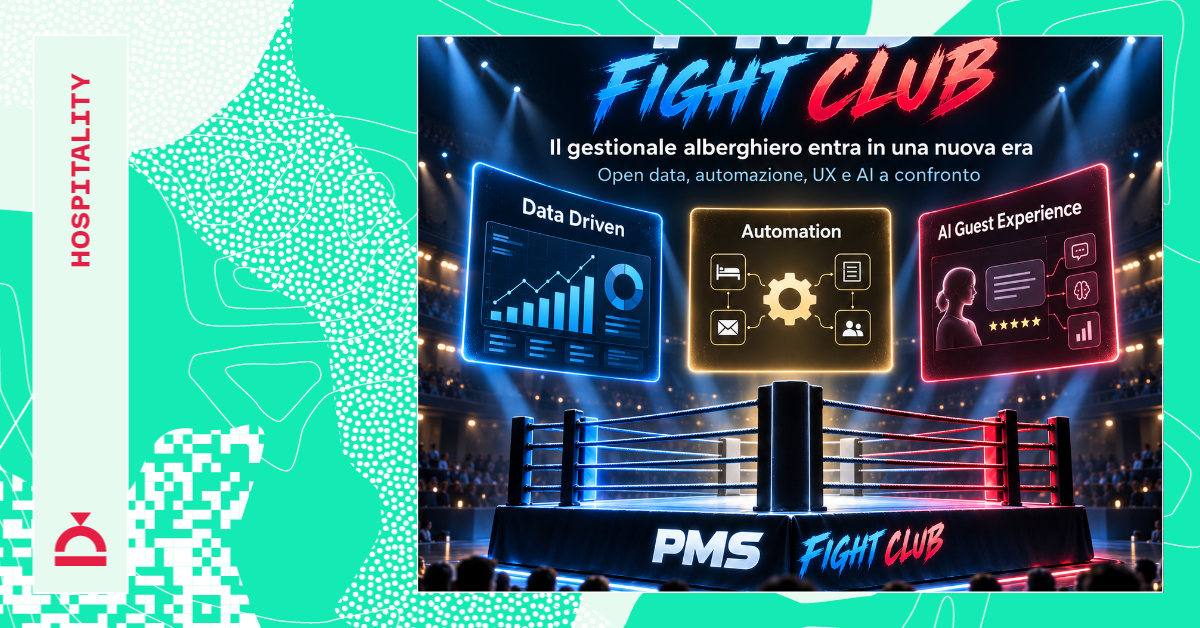
The PMS is no longer just front-desk software. Distribution, pricing, payments, CRM, housekeeping, reputation management, and artificial intelligence are converging into a single operational ecosystem. PMS Fight Club compares three different visions to understand what a management system needs to be capable of today, how open it should be, what role to assign to automation, and whether, in the future, the PMS will still be the hotel’s dashboard or the invisible engine that keeps it running.
It’s not the one with the most features who wins
For years, the PMS had a clear and reassuring scope: reservations, guest information, check-in, check-out, billing, rooms, and availability. It was “the management system,” and the main question when choosing one was almost always the same: Is it easy for the front desk to use? Today, that scope no longer exists. Even before comparing price lists and features, the question to ask has become a different one: What does a PMS really need to be able to do in 2026?
From the management software to the hotel’s operating system
Distribution, pricing, payments, housekeeping, guest communication, reputation, CRM, marketing, upselling, and data analysis are increasingly converging into a single system. The PMS is less like reception software and more like the hotel’s operating system. This changes the evaluation criteria: it’s not enough to ask whether a feature exists, but how quickly that feature integrates with everything else. Value doesn’t come from the number of software programs installed, but from the ability to make them work together.
Three perspectives, one ring
This is the inspiration behind PMS Fight Club: a showdown between three market leaders and three different approaches to hotel technology. Marco Matarazzi from Slope, Tommaso Tiberi from Mews, and Fabio Di Prima from HOTELCUBE will answer the same questions, defending their product and architectural choices live on air. No demos and no competition to see who can showcase the most features: the goal isn’t to declare a winner, but to understand the direction the industry is taking by listening to those who are shaping that direction.
The Real Battleground: Data Openness
For years, many hotel management software systems were essentially closed systems. The data was there, but exporting it, interpreting it, or making it available to other tools was often complicated. Today, this model is showing all its limitations, because innovation moves faster than the lifecycle of a management system. APIs, webhooks, and integration marketplaces are no longer the exclusive domain of large chains: they are essential for even an independent hotel to adopt new solutions without turning its PMS into the property’s technological bottleneck.
Automation: Not Just About Doing Things Faster, but Making Better Decisions
Sending a notification, generating an invoice, or synchronizing a rate means automating repetitive tasks and saving time. But the most interesting leap forward is something else entirely: a PMS that contributes to operational decisions. A system capable of analyzing occupancy, booking windows, booking trends, cancellations, and events can suggest a rate, flag a critical date, highlight upgrade opportunities, or draw attention to stays that warrant a follow-up. The goal isn’t to eliminate human labor, but to free up staff from low-value tasks so they can focus on the decisions that matter most.
UX isn’t about aesthetics—it’s about organization
Receptionists, revenue managers, housekeeping staff, administrative staff, and management often use different systems at the same time. Every unnecessary click, every duplicate entry, and every unintuitive screen creates inefficiency. That’s why the PMS user experience has become an organizational metric. A receptionist doesn’t need the same interface as a revenue manager, just as a manager shouldn’t have to manually search for data to understand how the day is going. Technology should reduce complexity, not shift it onto the user.
With AI, the rules are changing once again
Until yesterday, the relationship between people and software was straightforward: the user gave a command, and the system carried it out. Today, software can observe, interpret, suggest, and, in some cases, take action. The PMS could become a platform populated by co-pilots and agents: one prepares a response for the guest, one proposes a pricing strategy, one checks availability and conditions before suggesting an upgrade, and another monitors channel performance. We’re moving from a system that records what has happened to one that helps decide what should happen.
Will the PMS still be the dashboard?
This is perhaps the question that most divides the various perspectives. Will the PMS become the operational brain of the hotel, or will it evolve into an increasingly invisible infrastructure? It’s possible to imagine a scenario in which it continues to store data, reservations, inventory, and transactions, while day-to-day interactions take place through other layers: assistants, smart dashboards, and autonomous agents. The front desk clerk might no longer have to navigate through dozens of screens but simply ask which arrivals require attention; the manager might ask why next week’s RevPAR is lower than last year’s. The PMS would remain essential, but it would be the engine rather than the dashboard.
Openness, yes, but without naivety
There is also a second, more architectural scenario: the all-in-one software solution could give way to modular platforms in which payments, CRM, RMS, channel managers, reputation management, and business intelligence become interchangeable components, while the PMS serves as the connecting hub. In this case, value would not be measured by the number of proprietary features, but by the quality of the ecosystem built around the management system. Integration would itself become a feature—perhaps one of the most important ones.
The Real Challenge: Less Software, More Operational Intelligence
A hotel can use ten different software programs and still operate in a fragmented way. The challenge in the coming years won’t simply be purchasing new tools, but transforming technology and data into better decisions. This is the central focus of the discussion: understanding what features a PMS must have today, which integrations are now non-negotiable, how much to automate and how much to leave to staff, what questions to ask about APIs, webhooks, data exports, and data ownership, and, above all, what role to assign to artificial intelligence.
From the panel to a practical checklist
The audience won’t leave Fight Club with a winner, but with a checklist to use when evaluating or switching hotel management systems. Because competition among PMS systems is no longer about the number of features. It’s about the ability to make the hotel easier to manage, smarter in its decision-making, and quicker to adapt to what’s coming next. And that’s exactly where Fight Club begins.
This article offers a preview of the Hospitality program coordinated by Nicola Zoppi. Roberta Milano is the editor.
The discussion on this topic will take place at BTO – Be Travel Onlife; the program will be available online shortly.
To get a sneak peek, read interviews with speakers, and stay up to date on the latest news, subscribe to the newsletter and register with the special Early Bird rate , which expires on October 15.
We look forward to seeing you in Florence on November 10 and 11, 2026.
