
In the age of AI, narrative capital seems to be the true competitive advantage. From digital technology to artificial intelligence: how tourism and communication are changing for destinations, brands, and operators.
In recent months, the debate on artificial intelligence in tourism has focused heavily on tools: chatbots, virtual assistants, intelligent agents, and automated bookings. But the real question is this: what makes a destination or brand truly recognizable, memorable, and therefore recommendable—even by artificial intelligence—today?
This reflection is based on an article in issue 73 of the magazine *Orizzonti*, published by Eni— “The New Tourism,” a special issue dedicated to the sector’s transformations, which features contributions from scholars, managers, and key figures in Italian tourism, including Antonio Barreca, general manager of Federturismo Confindustria, and Anna D’Imporzano, general manager of Ravenna Civitas Cruise Port. This special issue examines tourism from different perspectives: economic, cultural, regional, and technological. In this context, I was asked to contribute an article on “Digital Tourism: How Demand, Supply, and Communication Are Changing.” The full article is available online. Below, I summarize its main points, expanding on them with some considerations that I believe are particularly relevant to the BTO community.
The Great Paradox of the Contemporary Tourist
As highlighted in the article, the key word in contemporary tourism is speed. If we consider the adoption of technology, the figures are staggering: “It took the telephone 75 years to reach 100 million users, cell phones 16 years, and WhatsApp 3 and a half years. ChatGPT did it in just two months.” The timeframes for understanding the market and competing are now measured in weeks, not decades.
We are facing a paradigm shift in which generative artificial intelligence is propelling us toward the era of autonomous agents. In this new scenario, “intelligent systems are moving beyond the purely advisory phase […] to behave as true autonomous agents,” capable of planning itineraries, optimizing budgets, and making reservations entirely on the user’s behalf.
Yet, in this hyper-technological ecosystem, a fascinating paradox emerges. The more the planning and booking process becomes digital, automated, and frictionless, “the more the desire for authenticity, real connection, and human interaction grows during the actual experience.” People seek technological efficiency before they leave precisely so they can afford the luxury of experiencing genuine relationships once they arrive at their destination. Hence the second keyword: trust.
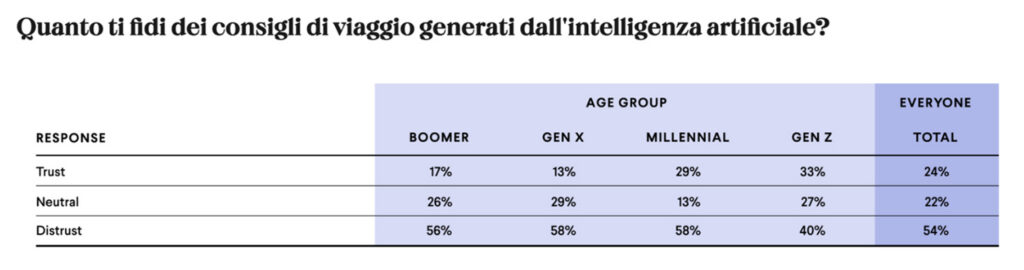
This trend is also confirmed by Wunderkind’s recent report on the future of travel, produced in partnership with Skift and featured in the July issue of the BTO Tourism Radar. According to the report, more than half (54%) of consumers still do not trust AI-based recommendations, with this skepticism being particularly pronounced among Baby Boomers and Generation X.
Offbeat Tribes: Beyond Segmentation, Toward a Sense of Belonging
This deep need for authenticity and immersive experiences (sought by 81% of travelers as early as the inspiration phase) takes us straight to the heart of the theme Offbeat Tribes , which will guide the next edition of BTO. In an era when artificial intelligence can generate standardized itineraries in a matter of seconds, competitive advantage no longer lies in meeting the needs of traditional demographic targets. The crucial shift for destination managers and operators is from classic static segmentation to the ability to tap into the fluid dynamics of tribes.
Today’s travelers seek both a deep sense of belonging and the affirmation of their own uniqueness. The concept of “offbeat”—thinking outside the box—doesn’t simply refer to alternative destinations; it encompasses shared values, specific ways of expressing oneself, and communities united by common passions.
Today, therefore, competitive advantage lies in being relevant on two fronts: to people and to intelligent systems. If a destination lacks its own identity and fails to nurture its niche audiences with meaningful communication and content, it will become invisible not only to tourists but also to artificial intelligence algorithms, which, by analyzing the web, reward precisely that humanity and imperfection that validate the authenticity of the story.
Food and Wine Tourism as a Form of Cultural Expression
Food and wine tourism is probably the sector in which this paradigm shift is most evident and significant. Food and wine are no longer perceived merely as a reason to travel or a set of dining services, but as a cultural gateway to understanding the soul of a region.
From this perspective, value is rooted precisely in communities and local micro-identities. Local products cease to be mere consumer goods and become important cultural expressions. Building a successful food and wine offering means creating, around products, exceptional offerings, and itineraries, a narrative capital that cannot be replicated elsewhere.
Consider, for example, the impact of “heroic” viticulture in areas with complex topography, but also visits to historic vinegar cellars, the growing number of olive oil tourism experiences among centuries-old olive trees, the discovery of artisanal cheese makers, or even immersing oneself in historic markets and food museums. These travelers are driven not only by the technical desire for a tasting, but by the desire to connect with the vision, history, and values of those who live and work on that land. This trend was already evident in last year’s interview, in which I analyzed the strengths and weaknesses of food and wine tourism. And we will continue to analyze them at BTO 2026.
These successful ventures—even when they’re small— generate enormous economic, reputational, and tourism value because they tell stories of hard work, radical choices, knowledge passed down through generations, and unbreakable ties to the land. An authentic narrative that varies from place to place—one that no AI platform could ever generate from scratch—but which the new digital travel assistants and agents are more than ready to capture and recommend to the right audiences. This represents a tremendous opportunity, especially for small villages and inland areas.
Technology Makes Creativity Even More Important
In the original text, I emphasized that, in today’s landscape, it is no longer enough to simply communicate; we must tell stories. And these are two profoundly different concepts. “The brain remembers what is told to us in narrative form 22 times better,” but storytelling requires the creation of “a veritable ecosystem made up of historical contexts, values, places, and people.”
We need to take this discussion further and explore its strategic implications. In the era of Generative Engine Optimization (GEO) and the widespread adoption of artificial intelligence, polished aesthetics and flawless synthetic content have now become a commodity. Grammatical accuracy, translation into dozens of languages, and the generation of perfect images are resources available to anyone at virtually no cost.
So, if “authenticity is becoming infinitely reproducible” (as Adam Mosseri, Head of Instagram,put it), and if we are immersed in a communication landscape characterized by an infinite abundance of perfect content and an equally infinite uncertainty about its actual authenticity, the content that will emerge is that which is capable of maintaining trust and conveying authenticity—by proving to be real, transparent, imperfect, and consistent. It is no longer enough simply to be visible.
What takes on crucial strategic value is professionalism—the ancient art of storytelling: a return to the fundamentals of effective communication. Human creativity and the ability to craft an emotional narrative are our only true defense against standardization. Transforming the identity of a region, a consortium, or a hospitality establishment into a recognizable narrative heritage requires sensitivity, strategic vision, and deep expertise.
Artificial intelligence is an extraordinary infrastructure for this narrative capital, but be careful: AI can “search for it, recognize it, and highlight it, but it cannot create it.”
The creative spark—the ability to give shape to the imagination, to evoke genuine emotions, and to connect with those new tribes that think outside the box— remains a profoundly and exclusively human endeavor.
The question we must ask ourselves—and one we’ll explore in upcoming in-depth articles both on the blog and on the BTO program—is precisely this: Are we truly capable of telling our story, and are we ready to do so? In other words, are we capable of collaborating with artificial intelligence and taking advantage of its immense opportunities, without, however, delegating creativity, innovation, and emotion to machines?
This article was written by Roberta Milano, coordinator of the “Food & Wine Tourism” section at BTO and editorial director of BTO.
We look forward to seeing you at BTO – Be Travel Onlife.
The event will take place in Florence on November 10 and 11, 2026.
