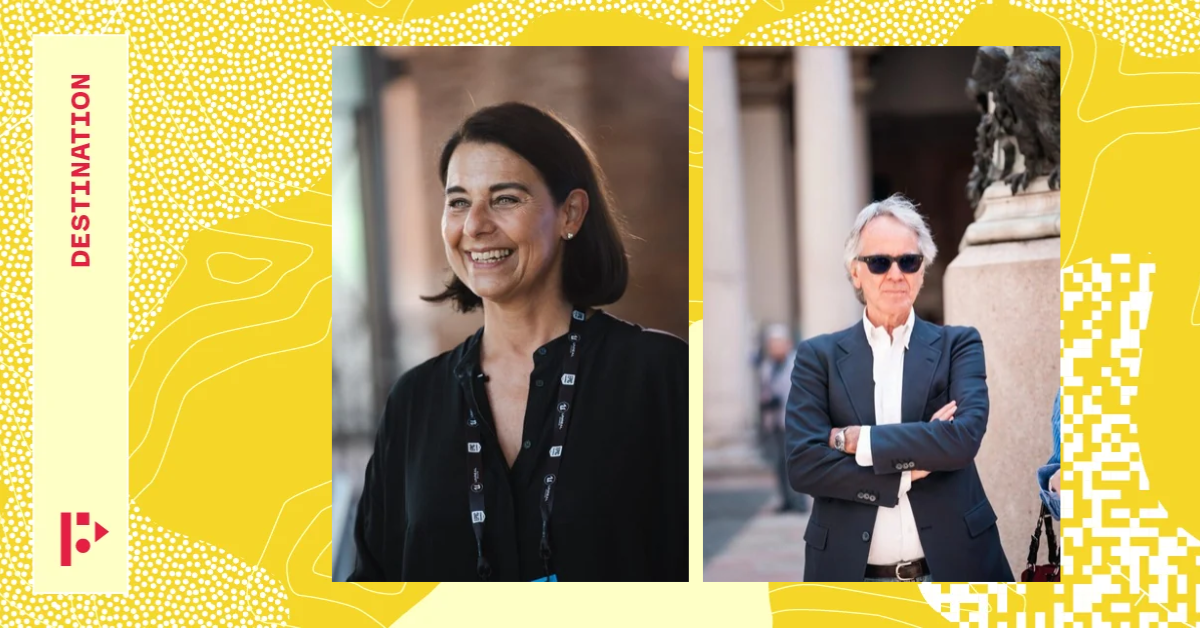
There are places we visit because we’ve seen them on screen. A scene or an atmosphere can turn a destination into a travel dream. But what happens when the magic of cinema meets real places? We discuss this in a double interview with Stefania Ippoliti, director of the Toscana Film Commission, and Enrico Ballarin of Mestiere Cinema, who worked on the production of “The Diplomat” for Netflix in Tuscany. Two perspectives, one story: the power of TV series to make us fall in love with places.
1. Stefania, these days, do we fall in love first with a place or with the story behind it? TV series let us step into the homes, streets, and lives of the characters. Sometimes those places become so familiar that we actually want to visit them. What makes a destination irresistible on screen? And why do TV series seem to have such a unique power of seduction compared to movies?
STEFANIA IPPOLITI I think it’s the story—the gateway through which desire is sparked. The narrative triggers a very powerful mechanism of fascination; this is true even when it comes to words, phrases, and dialogue… and when this is accompanied by images and sounds, the attraction is truly magnetic. Furthermore, storytelling through images uses sophisticated tools to refine, alter, or emphasize a setting, thereby adding a special magic that captivates us. When we watch a movie or a series, we surrender to the flow of the narrative without reality intruding; we’re all a bit like Alice through the looking glass… and therefore completely susceptible to its charm! Compared to movies, series have more time to do this: everything needed to fully unleash the spell.
2. Enrico, take us behind the scenes of *The Diplomat*. How do you transform a Medici Villa into a set for a Netflix series? A few minutes of footage can hide weeks of preparation, meetings, and delicate decisions. In your case, the dialogue with the management of the Medici Villas was particularly important. Can you tell us about a moment, a challenge, or an episode that illustrates what it means to reconcile the demands of fiction with a place that holds centuries of history?
ENRICO BALLARIN I must say that, fortunately for us, there were no real difficulties. Our meetings with the officials from the Medici Villas Directorate—and here I’d like to take this opportunity to thank Federica Bergamini and Paolo Cova—have always been based on a spirit of fruitful mutual collaboration. Furthermore, both Poggio a Caiano and La Petraia—the two villas featured in the filming of *THE DIPLOMAT*, which appear in all their splendor in the last two episodes of Season 4—are so beautiful, true gems, that any difficulty is easily overcome. However, they are located in places that are not exactly easy to access for a production of THE DIPLOMAT’s size, which involves a large number of crew members and technical equipment: trucks, semi-trucks, lighting cranes, trailers, catering stations, generators, etc. And there was a crew of over two hundred people, in addition to the cast and the large number of extras who worked with us at those locations. The entire cast was present at both locations: the four lead actors, along with the various characters who constantly surround them, other minor characters, and over two hundred extras, musicians, etc. So, with a presence of about five hundred people—what I call “a military occupation”—the main concern was to ensure that absolutely nothing in the incredibly precious environment where we operate was damaged. It wasn’t exactly easy—it never is—but I must say that we’ve gained some experience in this area and implement a series of specific measures for this purpose. In the interest of the site itself, and also in our own interest. After all, we want to be able to return to these locations for other productions—and perhaps, since we’re talking about a series, for the same production… you never know…
3. Stefania, Tuscany has been portrayed countless times. Can it still surprise us? From arthouse films to major international productions, Tuscany is one of the most recognizable landscapes in the world. Yet every story can reveal a different side of it. Is there a side of Tuscany that movies and TV series haven’t yet portrayed?
STEFANIA IPPOLITI It’s true, Tuscany has been and continues to be the subject of many stories, but I believe it can continue to play a leading role, to be a setting in films and series, without fear of exhausting its potential. I see this for myself: I’ve always lived here; I’ve looked at the landscapes, views, streets, squares, and monuments countless times, and I still get moved… I’m struck by a sense of longing, a happiness that time hasn’t worn away.
4. Enrico, what’s the magic that the viewer will never see? When we watch a series, everything seems natural: a building becomes a character’s home, a square the setting for a decisive encounter, a villa the backdrop for an international intrigue. While working on *The Diplomat*, what was the moment when you thought: “This scene on screen will look so simple, but no one will ever imagine what it took to pull it off”?
ENRICO BALLARIN When we enter a location—after managing to gain access—we then have to adapt it to the needs of the screenplay, the film, and the creative choices regarding set design, furnishings, and direction. Simply put, we have to transform it. The Petraia Hall became the venue for the G7 summit staged in the latest episode of THE DIPLOMAT. A little anecdote: the hall was created from an inner courtyard of the villa that was originally open to the sky. During the Savoy era, the courtyard was transformed into a ballroom by constructing a roof consisting of a gigantic iron-and-glass dome that, of course, lets light through. When filming, the light must be controlled. The main challenge at that location was finding a way to control the light, which naturally changes throughout the day. We therefore had to install a silk screen matching the dome’s impressive dimensions to filter the light and diffuse it throughout the space. A seemingly simple task, but not an easy one to carry out. And this is just a tiny example of what happens off-set that the viewer doesn’t notice—or rather, that the viewer perhaps perceives only subliminally. And this is one of the little magical touches of cinema.
5. Stefania, what if the real journey began when an episode ends? A series can leave the viewer with something that goes beyond the plot: the desire to explore a city, to rediscover a certain atmosphere, to feel part of that story. How can a region transform this emotion into an authentic encounter with its places, without reducing them to mere backdrops to be photographed?
STEFANIA IPPOLITI This is where a different profession from ours comes into play—the one you practice. You bring us back from a fantasy world to the real one, where we, as travelers, can be the protagonists. The magic is preserved by the serious work of professionals and their ability to ensure we’re never disappointed.
How much can a TV series change the fate of a place? It’s one of the questions at the heart of “The Allure of TV Series,” the panel discussion proposed and moderated by Stefania Ippoliti of the Toscana Film Commission. The panel will bring together the worlds of audiovisual production and research to explore the power of stories on the tourist imagination.
Speakers Marco Valerio Pugini (President of APE, Panorama Films), Enrico Ballarin (Mestiere Cinema), and Paolo Carelli (Catholic University). Moderated by Stefania Ippoliti (Tuscany Film Commission).
The interview was conducted by Cristina Pagani for the Destination section.
The event is scheduled forNovember 11, 2026, at 12:00 p.m. in Hall 4.
Choose here the BTO 2026 ticket that best suits your needs.
We look forward to seeing you in Florence for BTO – Be Travel Onlife.
