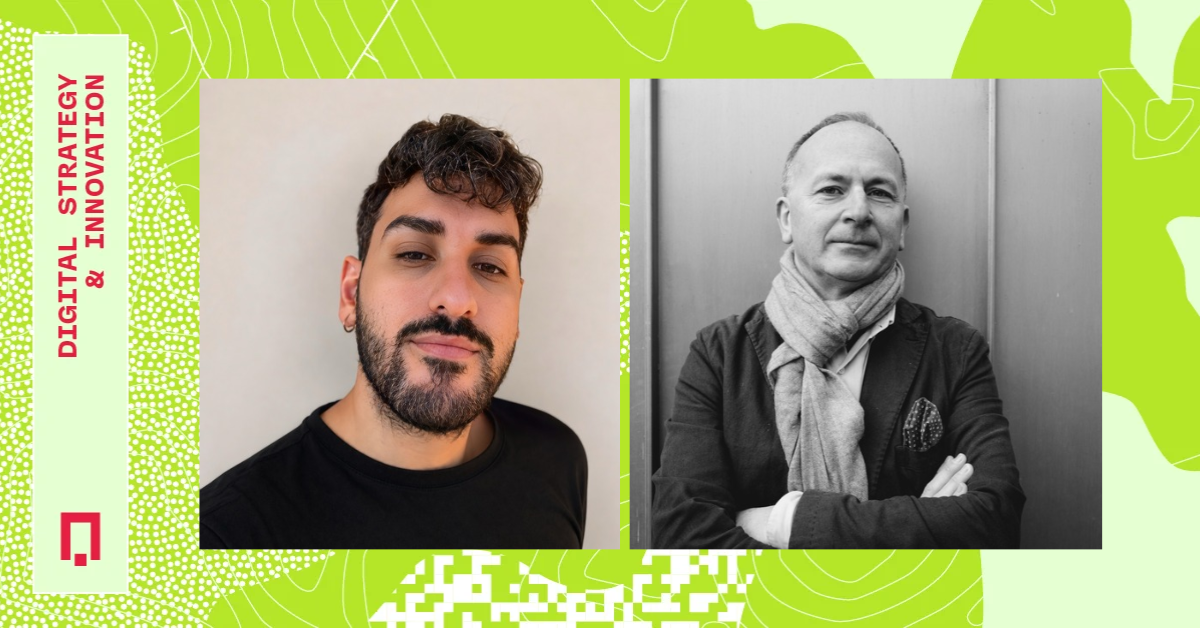
The tribes of BTO 2026 are formed based on common interests, but destinations are governed by territory. Amid communities demanding a voice, visitor flows that need to be managed, and an ever-increasing volume of data, who decides how a destination manages its own success—and by what criteria? We discuss this with Paolo Grigolli, a destination management professional, former director of the School of Tourism and Culture Management at tsm—Trentino School of Management, General Director of ApT Val di Fassa from 2021 to 2024, and subsequently coordinator of the Bormio DMO until the end of the Olympics. In October 2026, he was appointed General Director of Pugliapromozione.
The interview was conducted by Ottavio De Gregorio as part of the BTO 2026 Social Media LAB, the experimental and collective storytelling workshop dedicated to the new languages of tourism communication.
At BTO 2026, Grigolli will speak at the workshop “From Offbeat to Too Beat,” which explores situations where virality exceeds the capacity to accommodate it. Here, we broaden our perspective to include segments and communities of interest, resident participation, limits to growth, and the use of data in decision-making.
Ottavio: The BTO 2026 theme explores how travelers are increasingly coming together based on shared affinities and interests, often across geographical boundaries. Destinations, however, continue to operate along territorial lines. Should a destination continue to tailor its offerings to specific demand segments, or should it rethink how it perceives travelers?
Paolo: The two aren’t mutually exclusive. However, the order in which they’re used changes. Traditional segments—such as families, couples, or seniors—describe who the traveler is, not why they travel. Communities of interest, on the other hand, transcend age, background, and borders: those who ride gravel bikes, those who hike trails, those who sail or go ski touring, and those who travel for wine.
The territory remains the unit of management, because services, mobility, and regulations are governed at the local level. Based on our experience in developing tourist destinations in Trentino using the St. Gallen method, we built governance models starting from the visitor’s experience in the area: it may seem obvious, but this allowed us to approach product development from the perspective of demand, which, in practical terms, meant three things:
- design experiences based on “what tourists do,” even extending beyond administrative boundaries: a hiking trail or a cycling network that connects multiple valleys;
- form alliances with similar destinations, even those far away, for benchmarking purposes;
- engage with those who are already driving these communities—associations, guides, hospitality providers, and content creators—to develop the tourism economy and enable the region to welcome people with diverse needs related to their passions.
Starting with an analysis of the flows allowed us to build an innovative system for developing our offerings, upon which a solid governance framework was established.
Ottavio: Community involvement has become something of a mantra, but it often amounts to consultations that have little impact on actual decisions. What distinguishes genuine participatory planning from a mere formality? And when residents’ interests conflict with those of developers, who makes the decision, and based on what criteria?
Paolo: You can see the difference before and after the meeting, rather than during it. Formal participation brings people together when decisions have already been made, gathers opinions, and then doesn’t say what was done with them. Real participation works differently:
- immediately clarifies the scope of authority—that is, what is decided jointly and what remains the responsibility of the agency;
- provides data and information to facilitate an equal discussion;
- provides a written explanation of what was accepted, what was not, and why;
- results in visible changes to the plan or budget.
There’s a simple test: if the outcome would have been the same without the consultation, then the consultation was merely a formality. The administration—which bears responsibility—decides on conflicts between residents and business operators, but rules are needed. When one group bears more costs than others, compensation must also be provided. The fundamental principle is that residents’ quality of life is the prerequisite for sustainable tourism. It is therefore not at odds with the interests of business operators. Often, the conflict is less clear-cut than it seems, because many residents work in the tourism industry. The most important issue, in my view, is the time horizon, because we struggle to look 10–20 years ahead—which is the appropriate timeframe for a community to manage and absorb certain changes.
Ottavio: A place can quickly go from being little-known to facing intense tourist pressure. The shift from “offbeat” to “too beat” raises the issue of managing tourist flows: based on your experience in destinations like Val di Fassa and Bormio, what measures should a region put in place to prevent overcrowding? And when is it time to put a limit on growth?
Paolo: We’ve been working for over 50 years (and in many cases still do today) to attract tourists. Now we realize that we need to learn how to manage them by mastering a task for which we often lack the skills and, above all, the practical tools. Theory tells us that prevention means taking action before the problem becomes visible, even though this is often a claim that isn’t borne out by reality, given how tourism has evolved over the past few decades,
In any case, there are five tools that I consider essential:
- Continuous monitoring of foot traffic at critical points, such as crossings, entrances to hotspots, parking lots, and trails, along with residents’ perceptions. Thresholds for action must be defined in advance, and tools for collecting data must be put in place.
- Mobility management: This involves regulating access to the most vulnerable sites, introducing reservation-based parking and shuttle services, and, during the winter, integrating ski resorts with public transportation.
- Distribution over time and space: In recent years, we have worked hard in mountain destinations to develop experiences during the fall—which has become, in every sense, “a beautiful season”—and to highlight some less iconic locations that can be enriched with tailored experiences.
- A governance structure with actual authority over access and rules, not just over promotion in coordination with public administrations.
- Responsible communication: Stop promoting what’s already oversaturated, knowing full well that user-generated content (UGC) plays its part and cannot be controlled.
We could say that the time to set a limit comes when growth stops improving the lives of the people who live there. The signs are clear: increasingly expensive housing, strained services, uncontrolled price increases, residents leaving, and visitors who, in turn, are dissatisfied. The limit should be decided calmly, not in a crisis. And often it has less to do with the number of visitors than with the decline in the value of their tourist experience and the quality of life for residents.
Ottavio: Data and artificial intelligence offer new possibilities for forecasting tourist flows and shaping tourism strategies. But having more information doesn’t necessarily mean making better decisions. Which decisions a destination should make based on data, and which ones require consultation with local communities and institutions?
Paolo: I would base operational decisions on the data. For example:
- demand forecasting and flow distribution;
- parking and transportation capacity;
- evaluation of campaigns and events;
- allocation of the promotional budget.
In these areas, artificial intelligence saves time and reduces errors.
Decisions based on values, on the other hand, require dialogue with communities and institutions, but they also demand enlightened leadership—a rare commodity today. The difficult questions concern the kind of tourism we want, the places we need to protect, how to use land and housing, who bears the costs, and who reaps the benefits. Data can help us build scenarios and illustrate the consequences, but it cannot make decisions for us, because the answer depends on priorities that only a community can set for itself, taking into account at least the medium term and the experiences of other regions that have gone before us.
I’d like to add two caveats. First: data measures what is measurable—such as visitor numbers and spending—and risks overshadowing other aspects, such as identity and well-being. That’s why we also need indicators on residents’ perceptions. Second: data must be shared. Data that the community doesn’t see doesn’t build trust. When we consider that most destinations still rely on indicators such as arrivals and overnight stays, it’s clear we have a long way to go.
From travelers’ demands to data, and taking into account the voices of residents, Grigolli reminds us that a destination’s success must be managed before it becomes a problem. The numbers help us visualize the scenarios, but deciding what kind of tourism to develop and what to protect remains a choice for the community.
The event will take place on November 11, 10:00 a.m.–11:50 a.m., Hall #5, Stazione Leopolda, Florence:It’s a Short Step from Offbeat to Too Beat: A Co-Design Workshop for More Mindful Destination Communication, organized by Co-Design Toscana, with Paolo Grigolli, Marco Berni, Rita Duina, and Irene Marconi.
It is a workshop by reservation only for a maximum of 50 participants.
If you already have a ticket or a MyBTO account, log in and reserve your seat!
More information here.
Interview by Ottavio De Gregorio, BTO 2026 Social Media Lab.
