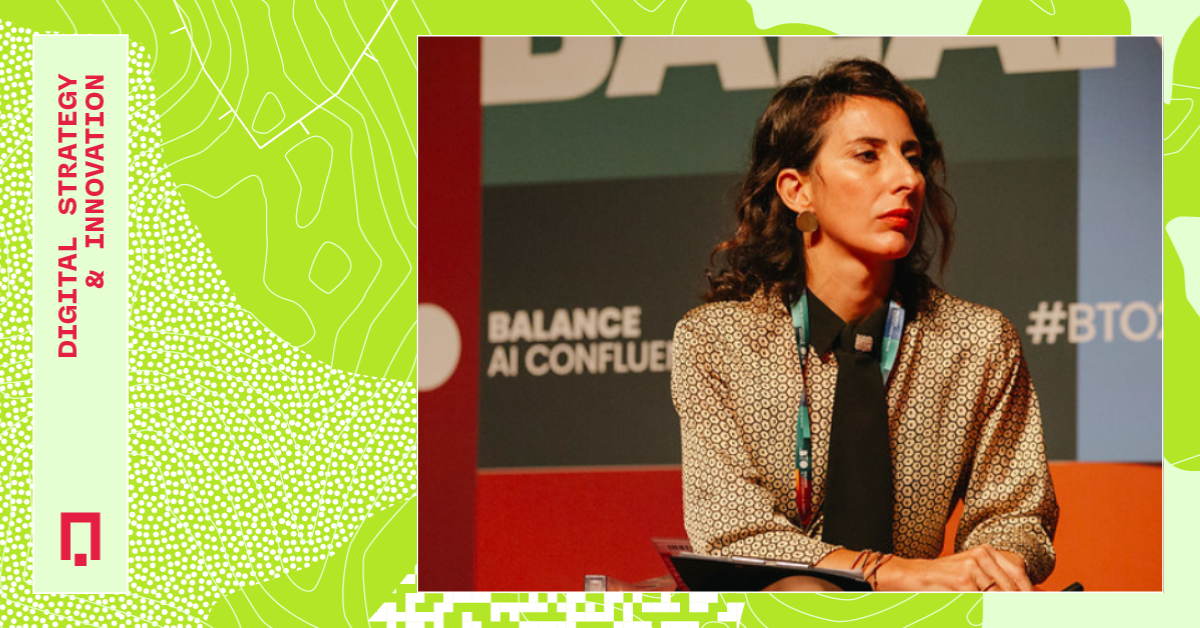
Signals, Algorithms, and New Travel Communities in the Age of AI.
In the BTO 2026 program, the “Digital Strategy” track, coordinated by Giulia Eremita, will explore an increasingly evident paradox: what happens when travel communities cease to be conscious choices and become fluid aggregations, reconstructed in real time by artificial intelligence? Amid the loss of intentionality in digital behavior and swarm dynamics that redefine decision-making, the challenge for destinations and operators is no longer simply to be found through a search, but to be relevant to the responses generated by generative engines. A journey to understand how new tribes emerge and what remains, today, of traditional strategy.
There is a question that served as the starting point for the Digital Strategy working group at the Advisory Board’s first meeting in Florence, and it is the same question that ideally opens the 2026 programming schedule: If traveler tribes are no longer stable segments but rather rapid, situational aggregations—almost like swarm dynamics—yes, the biological ones observed in nature, which we had already explored a few BTOs ago when discussing AI Swarm —what remains of the profession of those who create tourism products and experiences?
Until recently, choosing a “tribe” was, for the most part, a matter of personal choice. Those who planned their trips based on *Lonely Planet* identified with a specific style; those who followed the *Michelin Guide* chose a different one. These were voluntary communities, built around fairly recognizable passions, values, and codes.
What the working group observed is a further leap forward: today, artificial intelligence doesn’t just identify these tribes—it infers them in real time, often without the traveler being fully aware of it. Part of the program will therefore seek to understand how these new travel tribes emerge, evolve, and make choices—when imitation, a sense of belonging, and collective behavior begin to matter more than traditional market segments.
The click that no longer decides
There is one aspect, discussed in the working group, that closely concerns the phase in which the journey begins to take shape: the gradual loss of intentionality in digital actions. A scroll through social media is almost never a decision—it’s a reflex, fueled by a feed that suggests content even before an explicit need has arisen. The “like,” the save, the click—which once might have represented the first step in a conscious search—is now increasingly a signal that the system collects, combines, and reinterprets.
It’s an interesting reversal: whereas marketing used to start with a stated intention and try to tap into it, today a growing part of the work involves reconstructing an intention based on subtle, fragmented, and not necessarily conscious behavioral cues.
This leads to one of the themes that will run throughout the program: the shift from segments to signals. Creativity, machine learning, automation, and audience intelligence are no longer merely tools for meeting existing demand; they help build contexts in which interest can emerge. This line of thought inevitably extends to the AI economy as well: what happens to value, work, and decision-making processes when an ever-increasing portion of cognitive output is produced or mediated by machines?
Travel as a system, not as a moment
One of the most practical insights from this year’s Digital Strategy program concerns the need to view the journey in phases, each with its own logic: the pre-experience, dominated by AI, search, recommendations, and clustering; the experience itself, which remains the space for deviation, connection, and real contact; the post-experience, where content, reviews, and new signals are generated to fuel the next cycle.
Value is therefore distributed throughout the entire journey and is no longer concentrated solely at the time of travel or booking.
Part of the program will focus specifically on the phase leading up to the decision: on meta-search engines, platforms, recommendation systems, and the infrastructure that guides travelers even before their search becomes explicit. Another part will attempt to analyze, using data from major platforms, how the very reasons people travel are changing. And there will be an opportunity to explore how local search, data, and digital tools can help destinations be truly discovered and understood.
In this scenario, technology ceases to be a mere tool and becomes an invisible infrastructure that determines, at least in part, what exists in the user’s eyes.
The challenge, for a destination or an operator, is therefore no longer simply “being there,” but being recognized as relevant within the responses that generative systems produce. This is where the shift toward the new SEO (Search Experience Optimization), which incorporates LLMs, becomes a reality: destination websites must begin to function not only as tools for capturing traffic, but as reliable, structured sources that can be interpreted by generative engines and AI assistants.
The crux of the matter is a paradox made clear right from the name: the individual remains independent, free, and unique, yet chooses to be inter-dependent, connected, and collaborative. Not a mass, but a swarm: we move separately, yet we build collective directions. And even the interfaces of the future could follow the same logic, becoming progressively less visible, leading to the concept of a Zero UI that replaces part of the explicit interaction with systems capable of anticipating needs and context.
From Niche to Fluidity
It’s not so much the “what” that’s changing as the “how.” Niche interests already existed; today, what’s changing most is the speed at which they emerge, bring people together, and move from the digital to the real world.
The program will seek to examine precisely this transition: when a shared interest ceases to be merely a niche and becomes a community, an identity, a language, a brand, and ultimately a travel experience.
But the opposite trend also exists. A rapidly growing community can transform a remote location into an oversaturated destination in just a few weeks. Viral content, creators, and recommendation systems can generate demand much faster than a region can organize services, transportation, and hospitality capacity. This inevitably leads to a reflection on how to anticipate these phenomena before they become a sustainability issue.
This article was written by Giulia Eremita, scientific coordinator of the Digital Strategy and Innovation topic. Roberta Milano served as editor.
To learn more about the developments in these discussions, we look forward to seeing you at BTO – Be Travel Onlife. The event will take place in Florence on November 10 and 11, 2026.
Sign up for the newsletter to stay up to date.
